
Vacuum conveyor filter selection starts with the powder, the required airflow, and the cleaning process. Choose a filter that retains the relevant particles while maintaining conveying capacity throughout the operating cycle. Then verify its material compatibility, seals, cleaning limits, and any additional containment requirements.
A finer micron rating alone does not guarantee a better result. A filter that blocks quickly can reduce throughput, while an unsuitable seal can allow powder to bypass otherwise effective media. This guide explains how to compare designs and prepare a practical specification for your supplier.
For equipment configurations and published specifications, see the VTOPS vacuum conveyor feeder.
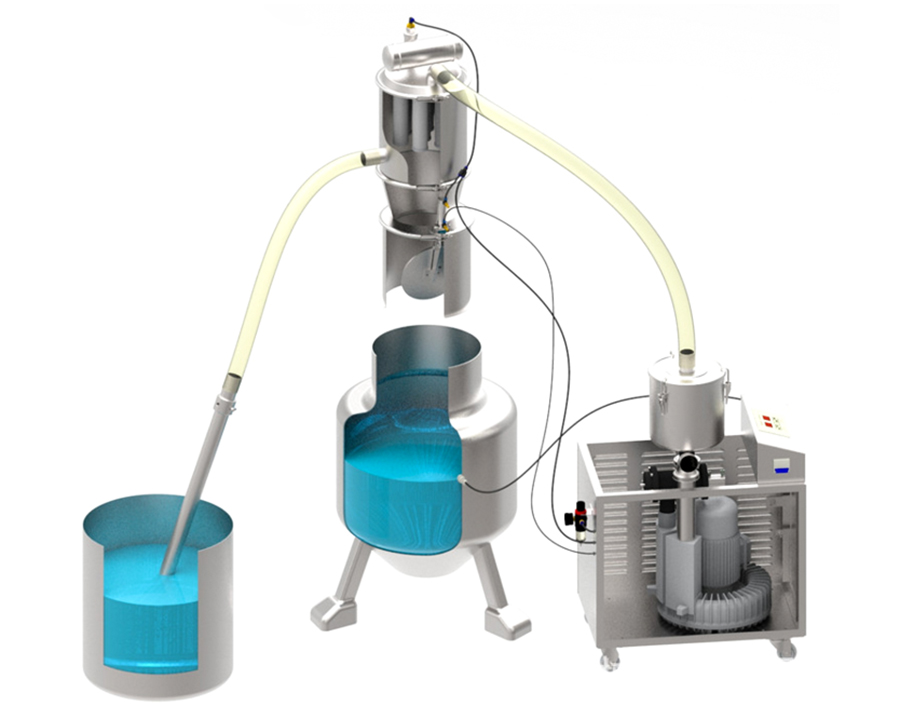
1. Vacuum Conveyor Filter Designs: What to Compare
Filter shape and filter material are separate choices. A cartridge can use different media, and two elements with similar dimensions can have different airflow and retention performance. Confirm compatibility with the receiver and cleaning assembly before choosing a replacement.
| Design | Potential advantage | What to verify |
|---|---|---|
| Cartridge or pleated element | Pleats provide filtration area within a compact space. | Powder release between pleats, mounting dimensions, seals, and approved cleaning method. |
| Bag or textile element | Flexible construction with media options for different duties. | Support arrangement, seam integrity, permeability, and compatibility with vacuum and cleaning cycles. |
| Disc or flat element | Fits receiver designs that use a flat filtration surface. | Available area and its intended role in the specific machine; shape alone does not determine whether it is a primary or auxiliary filter. |
For your vacuum conveyor filter, request both the effective filtration area and pressure-drop data at the intended airflow. Compare performance with powder loading as well as with a clean element.
2. Compare Filter Materials and Their Limits
The complete element includes more than its main filtration medium. Backing layers, adhesives, gaskets, and end fittings must also tolerate the powder, temperature, and cleaning chemicals.
| Material | Why consider it? | Selection limits |
|---|---|---|
| Polyester | A candidate for dry powders where its retention and airflow specifications meet the process needs. | Do not assume every polyester element is washable or suitable for food contact. Obtain documentation for the actual assembly. |
| PTFE membrane on a support | A candidate for surface filtration and improved powder release. | A membrane and a surface coating are different constructions. Ask which is supplied. Sticky or oily powders still require a conveying and cleaning trial. |
| 316L stainless steel | A candidate where metallic construction and specified cleaning or sterilization resistance are needed. | Mesh and sintered structures differ. Confirm retention, chemical compatibility, and approved cleaning cycles; 316L alone does not establish CIP or SIP suitability. |
| Sintered titanium | A specialist option when a documented compatibility assessment supports its use. | Do not assume universal corrosion resistance or better filtration. Evaluate the actual chemical, concentration, temperature, and complete assembly. |
Clean-in-place (CIP) and sterilize-in-place (SIP) describe processes that the equipment must support. Selecting a metal element does not by itself validate either process. Request written limits and cleaning instructions for the proposed vacuum conveyor filter.
Compare Filter Options for Your Powder
Share the particle-size data, moisture level, and cleaning method so our engineers can assess suitable filter configurations.
3. Understand Micron Ratings and HEPA Performance
A micron value is incomplete without its test method and removal efficiency. Ask whether a stated rating is nominal or absolute, how the supplier defines that term, and at what airflow the element was tested. Avoid comparing different suppliers solely by the smallest number in their brochures.
The VTOPS product page lists filter accuracy options of 0.4, 0.5, 5, and 10 µm. Treat these as published options to discuss with the supplier, not as equivalent efficiency certifications or automatic matches for particular industries.
HEPA is an efficiency designation, not a pore-size label of “≤ 0.3 µm.” The U.S. EPA explanation of HEPA filtration describes removal efficiency of at least 99.97% at 0.3 µm. This does not mean particles smaller than 0.3 µm simply pass through.
If HEPA filtration is specified, request the applicable standard, filter class, test report, rated airflow, and housing sealing requirements. A micron rating on a primary element is not evidence that the assembled conveyor provides HEPA performance.
There is no single micron rating that establishes food suitability. Vacuum conveyor filter selection must also address product-contact materials, cleaning, contamination risks, and the acceptance criteria for the actual process.
4. Decide Whether a Second Filtration Stage Is Needed
The receiver filter separates conveyed powder from the air stream. An additional stage may be specified to protect downstream equipment or meet defined containment and exhaust-air requirements. Its location and pressure loss must be included in the system design.
Do not select a universal “316L plus HEPA” package merely because a process involves pharmaceuticals. Define the product hazards, air discharge location, cleaning strategy, and required containment performance first. Where a high-efficiency stage is needed, its housing, seals, monitoring, and replacement method are part of the specification.
Similarly, an antistatic filter does not establish explosion protection for an entire conveying system. For combustible powders, have the equipment supplier and a qualified process-safety specialist assess the complete application.
5. Match Filter Cleaning to the Operating Cycle
Cleaning performance determines whether airflow recovers after repeated conveying cycles. Confirm how cleaning is triggered, how the receiver is emptied, and whether the filter can release the particular powder without damage.
| Method | Purpose | What to confirm |
|---|---|---|
| Reverse-air or pulse cleaning | Releases accumulated powder using reverse airflow; terminology varies by manufacturer. | Approved air pressure, pulse timing, air quality, and compatibility with the element. |
| Manual dry cleaning | Removes deposits during maintenance or changeover. | Permitted tools and handling procedure; aggressive brushing can damage sensitive media. |
| Wet cleaning | Removes residues where washing is permitted. | Approved chemicals, temperature, rinsing, drying, and inspection before reuse. |
| Mechanical shaking | Dislodges deposits in equipment designed for this method. | Compatibility with the receiver and element; it is not a universal retrofit. |
Use the vacuum conveyor filter manufacturer’s instructions rather than transferring cleaning limits from another model. Record whether pressure drop and throughput recover after cleaning, and investigate deterioration before simply increasing cleaning pressure.
For a line that feeds an auger filler, include downstream access and residue removal in the changeover review. The VTOPS guide to an easy-to-clean auger filler hopper discusses this connected maintenance task.
6. Troubleshoot Before Replacing the Filter
- Falling throughput: check filter pressure drop, cleaning operation, pickup conditions, pipe restrictions, and air leaks.
- Rapid blinding: review moisture, powder adhesion, available filter area, and cleaning effectiveness.
- Powder downstream of the element: inspect installation, seals, tears, and the retention specification before restarting normal production.
- Short service life: check abrasion, chemical exposure, handling damage, and cleaning limits.
Keep a baseline for clean-filter performance and compare it with normal operating records. Replacement decisions should reflect condition and process requirements rather than an unsupported universal calendar interval.
7. Vacuum Conveyor Filter Specification Checklist
Send the following information with an inquiry so competing proposals can be assessed against the same requirements:
- Material: powder identity, particle-size distribution including fines, bulk density, moisture, cohesiveness, and abrasiveness.
- Production target: required mass throughput, batch size, operating hours, and acceptable cleaning downtime.
- Installation: conveying distance, vertical lift, pipe diameter, bends, and receiving equipment.
- Filtration: required retention performance, test basis, airflow, clean and loaded pressure drop, and replacement criteria.
- Hygiene: contact-material documentation, cleaning procedure, changeover requirements, and drying time.
- Containment: dust hazards, air discharge location, secondary filtration needs, and safe maintenance arrangements.
- Acceptance trial: representative powder, target throughput, repeated cycles, powder carryover, and recovery after cleaning.
Evaluate the vacuum conveyor filter within the complete process. In a powder bottling line, agree on how material replenishment is coordinated with the filler. If packaged-weight verification is required, use the separate inline checkweigher selection guide; filter performance alone does not verify finished-pack weight.
Request an Application Review
Send your powder data, target throughput, conveying layout, and cleaning requirements so our team can review the filter and conveyor together.
Frequently Asked Questions
When do I need a HEPA filter for a vacuum conveyor?
Specify HEPA when the documented process, containment, or air-cleanliness requirement calls for that level of filtration. A pharmaceutical or cleanroom application needs an application-specific assessment; the industry label alone does not define every filter stage. Confirm the standard, airflow, test evidence, and housing seals.
What micron rating should I choose?
Use the powder’s particle-size distribution, acceptable carryover, and required airflow to define performance. Ask for efficiency at relevant particle sizes and pressure-drop data. A vacuum conveyor filter should meet the retention target while sustaining the required throughput over repeated cycles.
Will a PTFE membrane solve clogging with sticky powder?
It may be worth testing, but it is not a guaranteed solution. Moisture, oil content, filter geometry, and cleaning conditions can still cause deposits. Request a representative material trial that checks both conveying performance and powder release.
Is titanium better than stainless steel?
Neither material is universally better. Select a material against the actual chemical exposure and cleaning conditions, then compare retention, airflow, durability, and cost. Titanium should have a documented application-specific justification rather than being treated as a default premium upgrade.
Can I wash and reuse the filter?
Only when the manufacturer permits it for that exact element. Follow the specified cleaning and drying procedure, inspect the media and seals, and verify performance before reuse. Replace an element that is damaged or no longer meets the process requirements.
Need a Replacement Filter?
Provide the conveyor model, filter dimensions, material handled, and current operating problem so our team can check replacement compatibility.


