Pharmaceutical equipment maintenance is not simply a repair activity. It is a controlled lifecycle process that helps keep equipment safe, clean, capable, documented, and suitable for its intended use. An effective program connects engineering work with production, quality assurance, calibration, cleaning, validation, spare-parts control, and change management.
For pharmaceutical manufacturers and contract packers, the objective is not to eliminate every failure at any cost. The objective is to control equipment-related risks before they can affect product identity, strength, quality, purity, packaging integrity, data reliability, operator safety, or production continuity.
This guide explains how to build a risk-based pharmaceutical maintenance program, what records to keep, and how the approach applies to filling and packaging equipment. It provides practical guidance rather than legal advice; each facility should apply the regulations, marketing authorizations, quality system, OEM instructions, and local requirements that govern its operation.
What Is Pharmaceutical Equipment Maintenance?
Pharmaceutical equipment maintenance includes the planned and controlled activities used to preserve or restore the condition and performance of manufacturing, processing, packaging, laboratory, and utility equipment. It covers more than replacing failed components. A complete system normally includes:
- equipment inventory and criticality classification;
- preventive and predictive maintenance;
- corrective maintenance and breakdown response;
- inspection, lubrication, adjustment, and parts replacement;
- calibration coordination;
- cleaning and contamination controls during maintenance;
- documented return-to-service checks;
- change control, qualification, or revalidation when required;
- spare-parts and maintenance-tool control; and
- performance review and continuous improvement.
The program should distinguish maintenance from calibration, cleaning, and qualification while defining how they interact. Tightening a loose sensor bracket is maintenance. Comparing the sensor output against a traceable standard is calibration. Demonstrating that the equipment performs reproducibly over an approved operating range may be qualification. One work order can trigger all three activities, but their acceptance criteria and records are not interchangeable.
Why Pharmaceutical Equipment Maintenance Matters Under GMP
In the United States, 21 CFR 211.67 requires equipment and utensils to be cleaned and maintained at appropriate intervals to prevent malfunction or contamination. It also calls for written procedures covering responsibilities, schedules, methods, protection of cleaned equipment, pre-use inspection, and maintenance and cleaning records.
In Europe, EudraLex Volume 4 brings premises, equipment, documentation, production, computerized systems, and qualification and validation into the GMP framework. The ICH Q9(R1) Quality Risk Management guideline also identifies preventive maintenance, calibration schedules, cleaning, equipment qualification, and necessary spare parts as areas where risk management can be applied.
These sources do not prescribe one universal interval for every gearbox, auger, load cell, sealer, or sensor. The manufacturer must establish and justify controls appropriate to the equipment, process, product, use, and observed performance.
Equipment failures can create quality risks
A worn dosing tool can increase fill-weight variation. A drifting load cell can affect an in-process check. A damaged gasket can trap residue. An unstable sealing temperature can weaken package integrity. A misaligned label sensor can contribute to mix-ups. A failed reject device can allow a nonconforming pack to continue downstream.
Maintenance therefore supports both availability and the validated state. A machine that runs is not necessarily a machine that is ready for GMP production.
Types of Maintenance Used in Pharmaceutical Plants
| Maintenance type | Purpose | Typical trigger | Example |
|---|---|---|---|
| Preventive maintenance | Reduce predictable deterioration and failure | Calendar time, operating hours, cycles, or batches | Inspecting and replacing a sealer belt at a justified interval |
| Predictive or condition-based maintenance | Act on evidence of developing deterioration | Vibration, temperature, current, pressure, trend, or inspection result | Servicing a motor after abnormal vibration is confirmed |
| Corrective maintenance | Restore function after a defect is found | Failure, alarm, inspection finding, deviation, or operator report | Replacing a faulty photoelectric sensor |
| Reliability improvement | Remove a recurring failure mechanism | Trend review, root-cause analysis, or repeated work orders | Redesigning a cable support after repeated conductor damage |
Run-to-failure may be acceptable for a noncritical, easily replaceable component when failure cannot affect product quality, safety, records, or production continuity. It is rarely defensible as the default strategy for critical equipment.
Build a Risk-Based Pharmaceutical Equipment Maintenance Program
1. Create a controlled equipment inventory
Assign each asset a unique identifier and define its location, manufacturer, model, serial number, intended use, owner, manuals, drawings, parts list, qualification status, calibration requirements, software or firmware version where relevant, and maintenance history.
The inventory should include supporting equipment that can affect packaging performance, such as feeders, conveyors, dust collectors, compressed-air components, printers, vision systems, checkweighers, metal detectors, reject devices, and line-control systems.
2. Classify equipment by risk and criticality
Criticality should be based on the consequence of failure, not merely the purchase price of the machine. Consider whether a failure could:
- contact or contaminate exposed product;
- change a critical process or packaging parameter;
- affect dose, fill quantity, seal integrity, closure, coding, or label accuracy;
- disable an alarm, interlock, inspection, or reject function;
- damage an electronic record or audit trail;
- cause a safety or environmental event;
- create a long production interruption because no spare is available.
A simple low/medium/high classification may be sufficient for a small operation. More complex plants can use failure mode and effects analysis (FMEA) or another approved quality-risk method. The level of formality should be proportionate to risk.
3. Define tasks and acceptance criteria
“Inspect machine” is too vague. A useful maintenance task states what to inspect, how to access it, which tools and materials are permitted, what condition is acceptable, what measurement or test is required, which safety precautions apply, and what to do when the result fails.
Tasks should be based on OEM instructions, equipment history, component life, operating environment, product characteristics, cleaning exposure, regulatory or quality requirements, and engineering judgment. Use approved lubricants and prevent maintenance chemicals, metal fragments, loose fasteners, fibers, or tools from entering the product zone. Component-specific instructions—such as this screw conveyor feeder maintenance guide—should be incorporated into the site’s approved procedure rather than used as a substitute for it.
4. Establish risk-based frequencies
Maintenance frequency can be based on time, hours, cycles, batches, condition, or a combination. A machine processing abrasive powder may require different inspection intervals from the same model handling a nonabrasive product. A component exposed to frequent washdown may age differently from one used in a dry room.
Do not copy a generic monthly or annual schedule without justification. Start with the OEM recommendation and risk assessment, then refine the interval using work-order history, inspection findings, deviations, downtime, and replaced-part condition. Interval extensions should be documented and approved just as reductions are.
5. Plan people, tools, parts, and production access
Define the responsible role, required competency, estimated duration, lockout/tagout requirements, controlled tools, parts, permits, and production window. Quality-unit involvement should be established for tasks that affect product-contact surfaces, qualified settings, calibrated instruments, computerized systems, or batch disposition. Facilities receiving imported equipment should also verify the site’s supply against the machine specification; this overview of packaging machine power requirements in North America explains why voltage, phase, frequency, grounding, and transformer planning must be confirmed before installation.
Critical spares should be selected by risk. Consider lead time, failure consequence, shelf life, storage conditions, interchangeability, supplier control, and the ability to verify the part before installation. Unverified substitutions can create a change even when the replacement appears mechanically compatible.
Planning a maintainable pharmaceutical powder packaging line?
Pharmaceutical Equipment Maintenance Workflow
- Open and approve the work order. Identify the asset, reason, scope, risk, production status, and required permits.
- Place the equipment in a safe state. Stop production, identify material and batch status, isolate energy, and protect exposed product and clean areas.
- Control the maintenance area. Account for tools, parts, fasteners, lubricants, wipes, and removed components.
- Perform the approved task. Follow current procedures, drawings, and OEM instructions. Record actual findings and parts used.
- Clean and inspect. Remove maintenance residue and foreign material. Inspect product-contact and adjacent areas as required.
- Reassemble and challenge the function. Verify guards, sensors, interlocks, alarms, direction of movement, settings, and utilities. Electrical work should follow approved drawings and qualified-person requirements; the VTOPS guide to installing and wiring an electrical voltage transformer illustrates equipment-specific considerations that must be checked against the actual system.
- Assess calibration and qualification impact. Determine whether the intervention can affect a calibrated parameter, qualified state, computerized function, or validated process.
- Document return to service. Record test results, discrepancies, approvals, and the equipment status before releasing it to production.
- Review recurring failures. Investigate repeated defects rather than repeatedly restoring the same weak condition.
Documentation and Data Integrity
A maintenance record should allow another qualified person to understand what happened without relying on memory. Depending on the system and risk, capture:
- asset ID and location;
- date, time, and production or batch status;
- reported problem and observed condition;
- work performed and procedure revision;
- measurements, test results, and acceptance criteria;
- parts, lubricants, and materials used;
- technician and reviewer identification;
- cleaning and tool-accountability confirmation;
- calibration, qualification, deviation, or change-control references;
- return-to-service decision and authorization.
A computerized maintenance management system (CMMS) can schedule tasks, control asset history, track spares, and report overdue work. The system does not replace sound procedures or review. If electronic records are used for GMP decisions, the organization should assess applicable data-integrity and computerized-system controls.
When Maintenance Triggers Calibration, Qualification, or Change Control
Not every intervention requires requalification, but the impact must be assessed. Recalibration or functional verification may be appropriate after work on load cells, temperature controllers, pressure sensors, timers, encoders, vision systems, metal detectors, or checkweighers. Requalification or additional testing may be needed when work changes a critical setting, product-contact component, control logic, machine geometry, utility, material of construction, or operating range.
Examples include:
- replacing an auger screw with a different pitch or geometry;
- changing a sealing jaw, heater, controller, or thermocouple;
- modifying PLC logic, recipes, alarm limits, or reject timing;
- installing a substitute gasket, hose, lubricant, or contact material;
- moving equipment or changing electrical, air, vacuum, or extraction services;
- performing major gearbox, drive, frame, or control-system work.
The decision and rationale should be documented before routine production resumes. When product may have been affected before the failure was detected, initiate the appropriate deviation and product-impact assessment.
Maintenance of Pharmaceutical Packaging Equipment
Pharmaceutical packaging lines combine mechanical motion, dosing, container handling, sealing, coding, labeling, inspection, rejection, and electronic control. A failure at one station can affect the whole package or obscure the status of units already produced.
Powder filling and dosing equipment
For auger fillers, inspect the auger, funnel, agitator, hopper seals, coupling, bearings, drives, level sensors, and dust-extraction connections. Look for abrasion, buildup, looseness, contact between rotating and stationary components, and product traps. Challenge fill weight after work that can change dosing geometry, speed, timing, product flow, or weighing performance; these auger filler accuracy improvement methods provide additional context for variables that may need verification.
Ease of disassembly and cleaning should be considered when selecting equipment for hygienic applications. The design points discussed in this guide to an easy-to-clean auger filler hopper can help users define accessibility and changeover requirements. VTOPS offers configurations such as the tabletop dry powder auger filler and complete automatic powder bottling line solutions; the appropriate design and qualification approach depend on the product, container, process, and user requirements.
Pouch and bag packaging machines
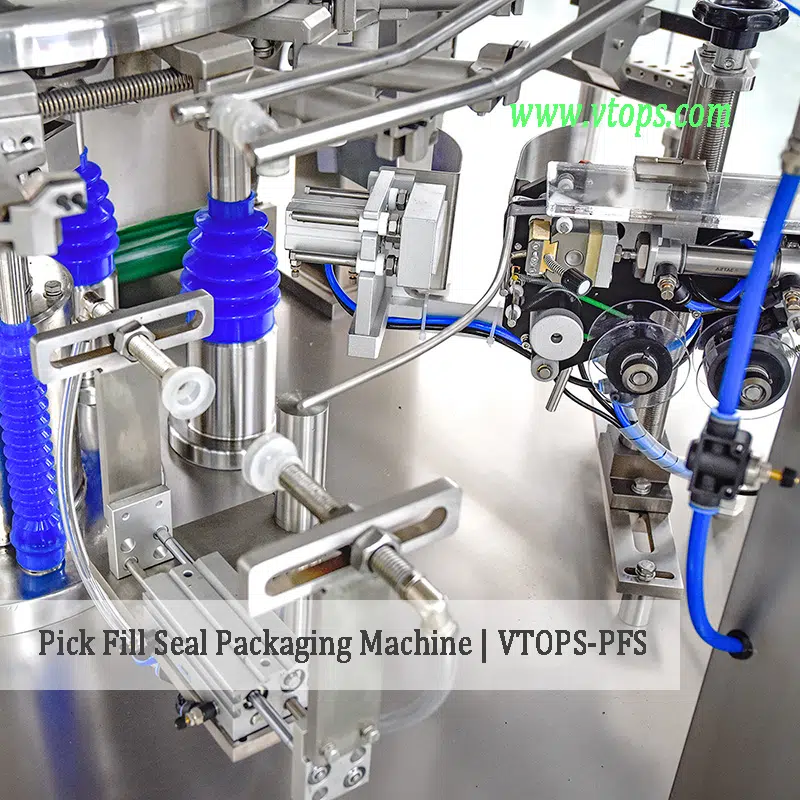
Inspect film or pouch handling, grippers, vacuum components, forming parts, sealing surfaces, heaters, temperature sensors, cutters, and code-position controls. After maintenance, verify package dimensions, seal appearance, seal parameters, coding, and any integrity test defined by the process. For powder sachets, review the operating principle and maintainability of the auger filler sachet packaging machine as one possible equipment configuration.
Conveying and feeding systems
Check filters, hoses, gaskets, clamps, screws, bearings, level controls, grounding, and dust containment. Confirm that dismantled parts are correctly reassembled and that no cleaning or maintenance material remains in the product path.
Capping, sealing, coding, and labeling
Inspect cap-handling components, chucks or spindles, torque-control elements, sealing temperature and pressure systems, printer mounts, label sensors, and container-positioning devices. Verify closure or seal acceptance criteria after an intervention. For continuous sealing equipment, a model-specific procedure such as the solid-ink coding band sealer maintenance guide can support task development. Ensure old batch and label information is removed or controlled before line clearance.
Inspection and rejection systems
Checkweighers, metal detectors, vision systems, and reject devices require more than a “runs normally” check. Challenge detection and rejection using approved test standards and verify reject confirmation, bin security, alarms, counters, and line-stop functions where applicable. The inline checkweigher buyer’s guide explains additional selection factors that also affect maintainability and verification.
Need equipment designed around your product and cleaning process?
Share your powder, package, capacity, accuracy, cleaning, and line-integration requirements with the VTOPS engineering team.
Practical Pharmaceutical Equipment Maintenance Checklist
| Control area | Questions to verify |
|---|---|
| Asset control | Is the asset uniquely identified, correctly located, and linked to current manuals, drawings, and maintenance plans? |
| Risk | Has product, patient, operator, data, and supply risk been assessed? Is the criticality current? |
| Schedule | Are frequencies justified by OEM guidance, risk, use, environment, and history? Are overdue tasks controlled? |
| Procedure | Does each task state the method, safety controls, permitted materials, acceptance criteria, and failure response? |
| Contamination control | Are product, clean surfaces, parts, tools, lubricants, and maintenance debris controlled? |
| Parts | Are installed parts identifiable and approved? Are critical spares available and correctly stored? |
| Testing | Are alarms, interlocks, guards, settings, rotation, sensors, and reject functions tested after work? |
| Quality impact | Has the need for deviation, calibration, qualification, validation, or change control been assessed? |
| Release | Is the work complete, reviewed, cleaned, documented, and formally returned to service? |
| Improvement | Are repeat failures, downtime, emergency work, and ineffective tasks trended and investigated? |
Common Maintenance Program Mistakes
- Using the same interval for every asset. Frequency should reflect risk, duty, environment, history, and component condition.
- Closing work orders without objective results. “Completed” does not show what was found, measured, replaced, or tested.
- Treating emergency repair as the end of the investigation. Repeated failures require root-cause analysis and effective corrective action. An event such as a tripped thermal overload relay should be assessed for its underlying load, electrical, mechanical, or operating cause before the machine is repeatedly reset.
- Ignoring contamination introduced by maintenance. Tools, swarf, lubricants, fibers, parts, and fingerprints can create product risk.
- Installing uncontrolled substitute parts. A dimensional fit does not prove material, performance, cleanability, or software equivalence.
- Returning equipment to production without quality-impact review. Successful movement alone does not confirm calibration, packaging performance, or validated status.
- Optimizing only for maintenance completion rate. A high on-time rate can hide ineffective tasks, excessive emergency work, and recurring defects.
Metrics That Show Whether the Program Works
Useful indicators should drive decisions rather than decorate a dashboard. Consider tracking preventive-maintenance compliance, overdue critical work, emergency-to-planned work ratio, repeat failure rate, mean time between failures, downtime by asset, maintenance-related deviations, calibration failures following maintenance, spare-part stockouts, and right-first-time return to service.
Review the metrics by equipment criticality. A small number of failures on a product-critical filler or reject system may matter more than many minor repairs on noncritical utilities. Use trends to revise tasks, frequencies, training, spare strategy, or equipment design.
Conclusion
An effective pharmaceutical equipment maintenance program is risk-based, documented, and connected to the pharmaceutical quality system. It starts with a controlled asset inventory, assigns appropriate criticality, defines precise work and acceptance criteria, prevents contamination during intervention, and requires evidence before equipment returns to production.
For packaging operations, maintenance must protect not only machine availability but also fill accuracy, package integrity, coding, labeling, inspection, rejection, and line-clearance controls. Selecting maintainable equipment and defining user requirements early can reduce future downtime and compliance risk.
Frequently Asked Questions
What is pharmaceutical equipment maintenance?
It is the controlled set of preventive, predictive, corrective, inspection, testing, and reliability activities used to preserve or restore pharmaceutical manufacturing and packaging equipment. The program also manages contamination controls, records, calibration impact, qualification impact, spare parts, and return-to-service decisions.
How often should pharmaceutical equipment receive preventive maintenance?
There is no single interval for all equipment. The frequency should be justified using equipment criticality, OEM recommendations, operating hours or cycles, product and process risk, environmental conditions, component history, inspection findings, and failure trends. Changes to an established interval should be documented and approved.
What is the difference between maintenance and calibration?
Maintenance preserves or restores equipment condition and function. Calibration compares a measuring function against an appropriate standard to determine or adjust its accuracy. Maintenance on a measuring component may trigger recalibration, but completion of one activity does not automatically satisfy the other.
Does every repair require requalification?
No. The organization should assess the repair’s effect on product quality, critical parameters, calibrated functions, computerized controls, and the qualified or validated state. Like-for-like minor work may need only documented functional checks, while changes to critical components, settings, software, utilities, or product-contact design may require calibration, partial qualification, or broader revalidation.
What records should be kept after pharmaceutical equipment maintenance?
Records normally identify the asset, date, reason for work, observed condition, work performed, procedure used, parts and materials, results against acceptance criteria, responsible personnel, cleaning status, quality-impact assessment, associated deviations or change controls, and authorization to return the equipment to service.
How should maintenance be handled on pharmaceutical packaging equipment?
Control the product and batch status, isolate energy, protect clean and product-contact areas, account for tools and parts, follow approved procedures, clean after intervention, and challenge affected functions. Depending on the work, verify dosing accuracy, seal parameters, torque, coding, labeling, inspection, alarms, interlocks, and rejection before release.


