Screw Feeder vs. Vacuum Feeder: Which is Best for Bulk Material Conveying?

Table of Contents

Screw Feeder vs. Vacuum Feeder: Which is Best for Bulk Material Conveying?

Screw Feeder vs. Vacuum Feeder: Understanding the Key Differences and Best Applications for Bulk Material Conveying

In the domain of bulk material conveying, screw feeders and vacuum feeders are indispensable tools utilized across industries such as packaging, food processing, pharmaceuticals, and manufacturing. While both systems are engineered to transport bulk materials effectively, their operating principles, applications, and advantages differ significantly. Gaining a clear understanding of these distinctions is essential for selecting the most suitable equipment for your specific requirements. Let’s delve into these two technologies in detail.


What is a Screw Feeder?

A screw feeder (also known as a spiral conveyor or auger conveyor) uses a rotating helical screw blade to move materials along a fixed tube or trough. It’s a reliable and widely used solution for conveying powders, granules, and small particulates in a controlled and consistent manner.

Key Features of Screw Feeders

  1. Mechanism: Rotating screw drives materials forward through a stationary channel.
  2. Material Suitability: Ideal for bulk materials like flour, grains, or fine powders.
  3. Capacity: Capable of high-volume material transfer with consistent output.
  4. Application Range: Commonly used in agriculture, food production, construction, and industrial packaging processes.

What is a Vacuum Feeder?

A vacuum feeder relies on suction created by a vacuum pump to pull materials through an enclosed pipeline. This method is particularly effective for transferring lightweight, fine, or non-sticky materials over longer distances or in applications requiring high levels of cleanliness.
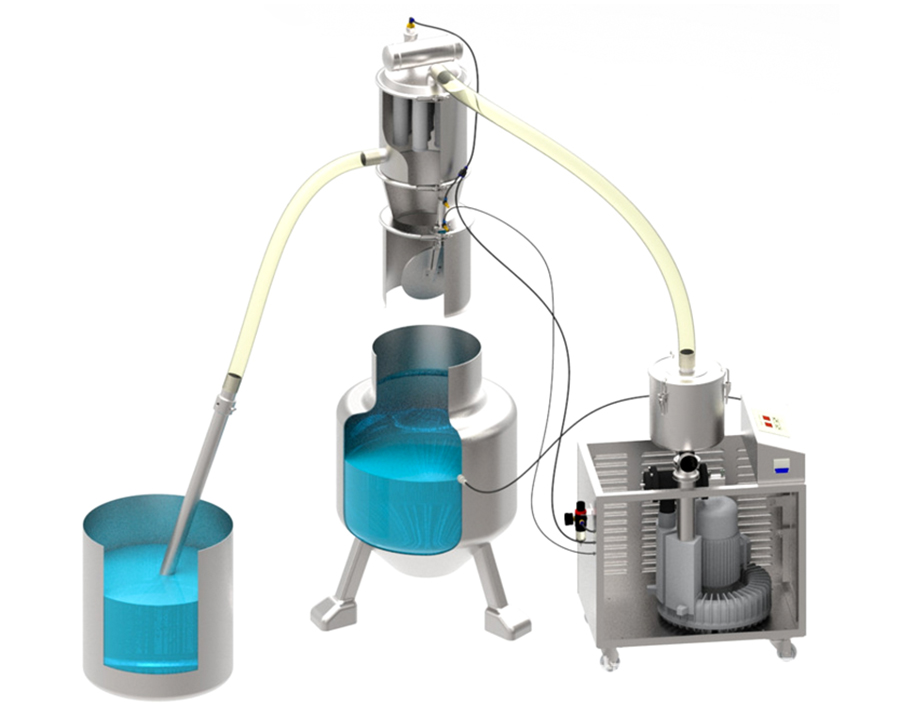
Vacuum Feeder
Diagram of Vacuum Conveyor Feeder

Key Features of Vacuum Feeders

  1. Mechanism: Negative pressure generated by the vacuum pump moves materials through an enclosed system.
  2. Material Suitability: Ideal for handling dry and non-sticky materials..
  3. Hygienic Design: The enclosed design minimizes contamination, making vacuum feeders perfect for pharmaceutical, food, and chemical industries.
  4. Flexibility: Can handle complex layouts, long distances, and height differences efficiently.

Screw Feeder vs. Vacuum Feeder: A Comparative Analysis

Aspect Screw Feeder Vacuum Feeder
Principle Uses a rotating screw blade to mechanically convey powder. Uses negative pressure to suction and transfer powder.
Material Suitability Ideal for bulk powder and granules. Suitable for dry, non-sticky, and fine powders.
Accuracy High accuracy, stable and continuous feeding. Moderate accuracy, depends on vacuum pressure stability.
Flexibility Best for short conveying distances (≤ 5 m). Excellent for long conveying distances (up to 50 m).
Hygiene  Open structure, potential contamination risks. Fully enclosed system, ensuring cleanliness and hygiene.
Maintenance Regular cleaning required due to moving parts.  Medium to high.

Selection Guide — How to Choose the Right Feeder

Choosing the right powder conveying system is crucial for ensuring stable production, product quality, and cost efficiency. The most common solutions are screw feeders and vacuum feeders — each with unique advantages depending on your material characteristics, conveying distance, industry requirements, and budget.
Below is a practical feeder selection guide to help you make an informed decision.

1. Based on Conveying Distance

  • Short conveying distance (generally within 3–5 meters): A screw feeder is often the most cost-effective and simple solution. It’s easy to install, stable, and ideal for short or horizontal transport.
  • Long conveying distance (more than 5 meters, or when elevation is required): A vacuum feeder is more suitable. It uses negative pressure to transfer powders over long distances with less risk of blockage and better dust control.

2. Based on Material Characteristics

  • Free-flowing powders (e.g., milk powder, starch, rice flour): A screw conveyor is usually sufficient and very efficient.
  • Dusty, ultra-fine, or hygienic-sensitive powders (e.g., additives, pharmaceutical powders): A vacuum conveying system offers cleaner transfer with minimal dust emission and higher containment.

3. Based on Cleaning & Industry Regulations

  • Pharmaceutical and food industries often require frequent cleaning and strict hygienic standards. A vacuum feeder is easier to disassemble and clean thoroughly, making it ideal for these regulated industries.
  • General packaging lines (such as chemical or additive industries) can use screw feeders, which are simple to maintain and more budget-friendly.

4. Based on Budget & Production Scale

  • Small or entry-level production lines can start with screw feeders to minimize initial investment while maintaining stable performance.
  • High-volume or automated production lines benefit from vacuum feeders, which support continuous conveying with lower labor and cleaning costs over time.

👉 Contact VTOPS to customize your powder conveying solution — Our engineers will help you select the most suitable feeder system based on your material, plant layout, and production goals.


Common Problems and Maintenance Tips

Even the best powder conveying system can encounter issues during daily operation. Understanding the common problems of screw feeders and vacuum feeders — and learning how to maintain them properly — can significantly improve equipment reliability, reduce downtime, and extend service life.

1. Common Issues with Screw Feeders

  • Material clogging (堵料): When conveying cohesive or moist powders, the screw can easily jam, causing uneven feeding or line stoppage.
  • Powder bridging (粉末架桥): Poorly flowing powders may form bridges in the hopper, preventing smooth feeding.
  • Screw wear (螺杆磨损): Long-term use with abrasive materials accelerates wear, reducing accuracy and capacity.

👉 Maintenance Tip:

  • Install anti-bridging agitators or vibration devices.
  • Schedule regular inspection of the screw and replace worn components promptly.
  • Keep the hopper clean and dry to minimize buildup.

2. Common Issues with Vacuum Feeders

  • Vacuum leakage (真空泄漏): Loose seals or cracked hoses can lead to unstable conveying and lower efficiency.
  • Filter blockage (滤芯堵塞): Fine powders can clog filters, reducing suction and capacity.
  • Unstable conveying (输送不稳定): Improper air-to-material ratio or poor sealing may result in fluctuating flow rates.

👉 Maintenance Tip:

  • Regularly check all sealing points and hoses.
  • Clean or replace filters according to the manufacturer’s recommended cycle.
  • Ensure proper material feeding to keep the conveying pipeline balanced.

3. Recommended Maintenance Schedule

Maintenance Task Screw Feeder Vacuum Feeder
Routine inspection Weekly Weekly
Deep cleaning Every 2–4 weeks Every 4–6 weeks
Seal check / filter check Every 2 weeks
Screw or wear part replacement Every 18–24 months Every 12–18 months

Pro Tip:Adjust maintenance frequency based on your material type, production intensity, and cleanliness requirements.

4. Installation Mistakes & How to Avoid Them

  • Wrong angle or hopper design → leads to powder bridging and unstable feeding.
    Use a proper hopper angle and consider agitation devices for cohesive powders.
  • Improper sealing → causes leakage, reduced vacuum efficiency.
    Check all gaskets and hoses carefully during installation.
  • Ignoring grounding and static control → especially critical for fine powders.
    Install grounding wires to avoid static buildup.
  • Lack of alignment between feeder outlet and next machine → can cause blockage or dust escape.
    Ensure smooth transitions and proper alignment during assembly.

FAQ Section

Q1: Which feeder is better for long-distance powder conveying?

A: A vacuum feeder is more suitable for long-distance conveying. It uses negative pressure to transfer materials efficiently over extended distances, minimizing dust and ensuring a cleaner working environment.

Q2: Which feeder is more cost-effective?

A: A screw feeder is usually more budget-friendly for short-distance conveying. It has lower initial investment costs and is easy to operate and maintain, making it ideal for small to medium production lines.

Q3: Can I combine both systems?

A: Yes. A hybrid solution that combines screw and vacuum feeders is commonly used in complex or multi-stage production lines, allowing flexible layout, better conveying efficiency, and reduced material handling time.


Conclusion — Screw Feeder or Vacuum Feeder?

Both screw feeders and vacuum feeders are powerful and reliable solutions for bulk powder conveying. The best choice depends on your production scale, conveying distance, hygiene requirements, and budget.

  • Short distance + lower costScrew feeder is often the smarter and more economical choice.
  • 🚀 Long distance + hygienic or dust-free conveyingVacuum feeder provides better performance and cleaner operation.

Screw feeders shine in simple, short-distance conveying with minimal investment, making them ideal for small and medium packaging lines. Vacuum feeders, on the other hand, excel in long-distance, high-precision, and sanitary applications, such as food, pharmaceutical, or high-volume production.

👉 Contact VTOPS to get a customized feeder solution tailored to your material, layout, and production goals. Our team can also help design hybrid systems that combine both screw and vacuum technologies for maximum flexibility and ROI.

On Key

Related Posts

Scroll to Top