Volumetric Cup Filler vs Auger Filler: Which Filling Machine Is Right for Your Product?
When selecting a filling machine for food, chemical, agricultural, or pharmaceutical products, one of the most common questions is whether a volumetric cup filler or an auger filler is the better choice.
Both technologies are widely used throughout the packaging industry, but they are designed for different product characteristics, accuracy requirements, production capacities, and budgets.
At VTOPS, we manufacture and supply both volumetric cup filling machines and auger filling machines to customers in more than 80 countries. Based on our practical experience, this guide compares the two technologies and helps you determine which solution is best for your application.
Quick Answer
Choose a Volumetric Cup Filler if you package free-flowing granules such as sugar, rice, beans, seeds, or coffee beans.
Choose an Auger Filler if you package powders such as milk powder, protein powder, coffee powder, flour, spices, or chemical powders.
If filling accuracy is critical, Auger Fillers are usually the better choice.
Not Sure Whether You Need a Volumetric Cup Filler or an Auger Filler?
Quick Comparison: Volumetric Cup Filler vs Auger Filler
| Feature | Volumetric Cup Filler | Auger Filler |
|---|---|---|
| Reference Image | ||
| Suitable Products | Free-flowing granules | Powders & fine granules |
| Filling Principle | Volume-based | Screw-based dispensing |
| Accuracy | Medium | High |
| Typical Accuracy | ±1% to ±3% | ±0.5% to ±1% |
| Machine Cost | Lower | Higher |
| Maintenance | Simple | Moderate |
| Best For | Sugar, rice, beans, seeds | Coffee powder, milk powder, spices |
What Is a Volumetric Cup Filler?
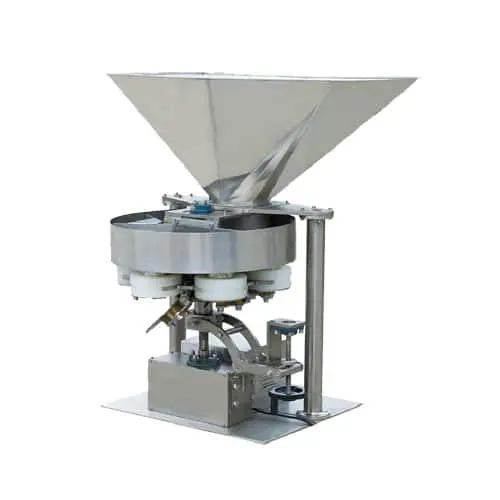
A volumetric cup filler measures products by volume using adjustable measuring cups. During operation, the cups are filled with product and then emptied into containers or bags.
This technology is widely used for free-flowing granular products with relatively consistent density. Because the filling volume remains fixed, production speeds can be high while machine structures remain simple and economical.
Typical applications include:
- Rice
- Sugar
- Beans
- Seeds
- Coffee beans
- Pet food granules
- Fertilizer granules
How a Volumetric Cup Filler Works
A volumetric cup filler operates by measuring products according to volume rather than weight. During production, product is fed into a hopper where a set of adjustable measuring cups is continuously filled.
As the machine rotates, each cup captures a predetermined volume of product. Once filled, the cup moves to the discharge position and releases the product into a package, bottle, jar, or container.
Because the filling volume remains constant, volumetric cup fillers can achieve high production speeds with relatively simple mechanical structures. However, the actual package weight may vary if the product’s bulk density changes during production.
For this reason, volumetric cup fillers are typically recommended for free-flowing products with stable density characteristics, such as rice, sugar, beans, seeds, coffee beans, and pet food pellets.
What Is an Auger Filler?
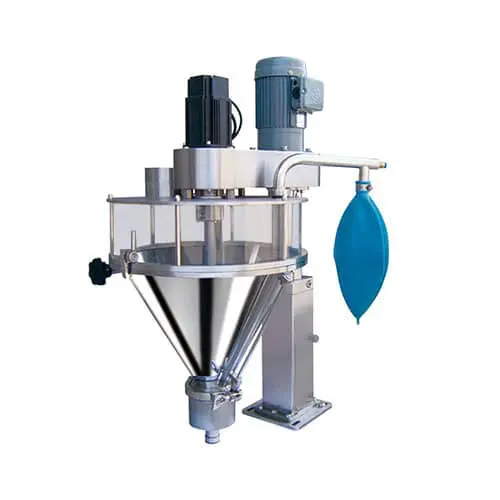
An auger filler uses a rotating screw (auger) to precisely dispense products. The screw transports material from the hopper into the package, allowing highly controlled filling.
Auger filling technology is particularly suitable for powders and products that do not flow consistently.
Typical applications include:
- Milk powder
- Protein powder
- Coffee powder
- Flour
- Spice powder
- Nutritional supplements
- Chemical powders
How an Auger Filler Works
An auger filler uses a rotating screw, known as an auger, to dispense product into a package or container. Product is stored inside a hopper and continuously fed toward the filling screw.
When a filling cycle begins, the servo motor rotates the auger a precise number of revolutions. The screw then transfers a controlled amount of product through a filling tube and into the package.
Because the filling volume is controlled by screw rotation, auger fillers provide excellent repeatability and filling accuracy. Modern auger filling machines can also be integrated with weighing systems to further improve precision.
Auger fillers are widely used for powder products that may not flow consistently, including milk powder, protein powder, coffee powder, flour, spices, chemical powders, and nutritional supplements.
Volumetric Cup Filler vs Auger Filler: 8 Key Differences
1. Product Characteristics
The most important factor is the product itself.
Volumetric cup fillers perform best with free-flowing products that have relatively stable bulk density. Auger fillers are designed for powders, fine particles, and products that may compact or bridge during filling.
2. Filling Accuracy
Auger fillers generally provide higher accuracy because the filling process is precisely controlled by servo motors and screw rotation.
Volumetric cup fillers can achieve excellent consistency for many products, but variations in product density may affect actual package weight.
3. Production Speed
Both technologies can achieve high production speeds when properly configured.
For many free-flowing products, volumetric cup fillers can provide extremely fast and stable operation. Auger fillers can also achieve high speeds, particularly when integrated with modern VFFS packaging machines.
4. Equipment Cost
Volumetric cup fillers generally have a lower initial investment because of their simpler mechanical structure.
Auger filling systems typically require servo motors, precision screws, and advanced control systems, resulting in higher equipment costs.
5. Product Flexibility
If you frequently package different powder products, auger fillers offer greater flexibility and easier adjustment.
Volumetric cup fillers perform best when filling products with similar flow characteristics and density.
6. Maintenance Requirements
Volumetric cup fillers have relatively simple mechanical structures and are easy to maintain.
Auger fillers require periodic inspection of screws, agitators, bearings, and drive components to maintain optimal performance.
7. Long-Term Scalability
For manufacturers planning to expand into higher-value powder products, auger filling systems often provide greater long-term flexibility and accuracy.
For companies focused on free-flowing granular products, volumetric cup fillers remain a highly cost-effective solution.
8. Product Giveaway Cost
Many manufacturers focus on machine price when selecting filling equipment. However, product giveaway can often have a greater impact on long-term operating costs than the initial machine investment.
For low-cost products such as rice or beans, small weight variations may have little financial impact. In these cases, a volumetric cup filler can be an economical and practical solution.
For higher-value products such as protein powder, nutritional supplements, pharmaceutical powders, or specialty ingredients, even a small overfill percentage can result in significant product loss over time.
Because auger fillers generally provide higher filling accuracy, many manufacturers find that the reduction in product giveaway helps offset the higher initial equipment cost.
Need Help Choosing the Right Filling Technology?
Which Products Are Better Suited for Volumetric Cup Fillers?
Volumetric cup fillers are often the preferred solution for:
- Granulated sugar
- Rice
- Beans
- Corn kernels
- Coffee beans
- Pet food pellets
- Seeds
- Plastic granules
These products typically flow consistently and can be accurately measured by volume.
Which Products Are Better Suited for Auger Fillers?
Auger fillers are typically recommended for:
- Milk powder
- Protein powder
- Coffee powder
- Flour
- Seasoning powders
- Nutritional supplements
- Chemical powders
- Fine pharmaceutical powders
These products often require precise filling control and can be difficult to measure accurately using volumetric methods.
Real Customer Examples
Coffee Powder Packaging
A customer initially considered a volumetric cup filler to reduce equipment investment. After reviewing the product characteristics and required accuracy, an auger filling machine was selected because coffee powder density can vary significantly during production.
Granulated Sugar Packaging
For a customer packaging free-flowing granulated sugar, a volumetric cup filler provided sufficient accuracy while reducing overall equipment costs and maintenance requirements.
What We Have Learned from Hundreds of Filling Projects
Based on our experience supplying filling equipment to customers in over 80 countries, the most common mistake is selecting equipment based solely on initial machine cost.
In many cases, a slightly higher investment in the correct filling technology reduces product giveaway, improves consistency, and lowers long-term operating costs.
Can a Volumetric Cup Filler Replace an Auger Filler?
In some applications, a volumetric cup filler may successfully replace an auger filler, particularly when packaging free-flowing granular products such as rice, sugar, beans, seeds, and coffee beans.
However, for powder products such as milk powder, coffee powder, flour, protein powder, spices, and chemical powders, auger fillers generally provide superior accuracy and consistency.
The decision should be based on product flowability, density variation, target weight, and acceptable filling tolerance.
While volumetric cup fillers often offer a lower initial investment, selecting the wrong technology can lead to product giveaway, weight inconsistency, and customer complaints.
How to Choose the Right Filling Machine
Choose a Volumetric Cup Filler if:
- You package free-flowing granules.
- You want lower equipment costs.
- You prioritize simplicity and easy maintenance.
- Weight accuracy requirements are moderate.
Choose an Auger Filler if:
- You package powders.
- You require higher filling accuracy.
- You handle products with variable density.
- You need greater flexibility for different products.
Common Mistakes When Choosing a Filling Machine
Choosing Based Only on Equipment Price
Many manufacturers focus only on machine cost. However, filling accuracy, product giveaway, maintenance requirements, and future expansion should also be considered.
Ignoring Product Density Variations
Products with unstable density may perform poorly on volumetric systems, even if they appear suitable during initial testing.
Overlooking Future Product Changes
If your company plans to introduce additional powder products in the future, an auger filling system may provide greater flexibility.
Not Testing Actual Product Samples
Laboratory specifications rarely tell the whole story. Whenever possible, product samples should be tested before final machine selection.
Cost Comparison
| Machine Type | Typical Investment Range |
|---|---|
| Volumetric Cup Filler | USD 2,000 – 8,000 |
| Auger Filler | USD 4,000 – 20,000+ |
Actual pricing depends on automation level, filling range, accuracy requirements, and integration with packaging systems.
Volumetric Cup Filler vs Auger Filler for Different Products
| Product | Recommended Solution | Reason |
|---|---|---|
| Milk Powder | Auger Filler | High accuracy required |
| Coffee Powder | Auger Filler | Density varies significantly |
| Protein Powder | Auger Filler | Fine powder consistency |
| Flour | Auger Filler | Dust control and accuracy |
| Sugar | Volumetric Cup Filler | Free-flowing granules |
| Rice | Volumetric Cup Filler | Consistent volume filling |
| Beans | Volumetric Cup Filler | Simple and cost-effective |
| Coffee Beans | Volumetric Cup Filler | Stable granular product |
Conclusion
Neither technology is universally better. The best solution depends on your product characteristics, required accuracy, production capacity, and budget.
In general, volumetric cup fillers are an excellent choice for free-flowing granular products, while auger fillers remain the preferred solution for powders and applications requiring higher accuracy.
If you are unsure which technology is best for your application, our engineers can evaluate your product and recommend the most suitable solution.
If you are comparing filling technologies for a new packaging project, providing product samples is the most reliable way to determine the optimal solution. At VTOPS, we routinely test customer products and recommend filling systems based on actual performance rather than theoretical specifications.
Still Unsure Which Filling Machine Is Best?
Machine selection depends on product flowability, filling accuracy, production speed, and budget. Let our engineers help you evaluate the options.
Frequently Asked Questions
Which machine is more accurate, a Volumetric Cup Filler vs an Auger Filler?
Auger fillers generally provide higher filling accuracy because the product is dispensed through a servo-controlled screw mechanism. Typical accuracy can reach ±0.5% to ±1%, depending on the product and filling weight.
Volumetric cup fillers measure by volume rather than weight and are more sensitive to changes in bulk density. For products requiring strict weight control, auger fillers are usually the preferred solution.
Can a Volumetric Cup Filler Replace an Auger Filler?
In some applications, yes.
Volumetric cup fillers can be an excellent alternative for free-flowing products such as rice, sugar, beans, seeds, and coffee beans. However, for powders such as milk powder, protein powder, coffee powder, flour, and spices, density variations often make auger filling technology the more reliable choice.
The final decision should be based on product characteristics, accuracy requirements, and acceptable filling tolerances.
Which Filling Machine Is Better for Coffee Products?
The answer depends on whether the product is coffee powder or coffee beans.
Coffee powder is typically filled using auger fillers because powder density can vary during production and storage. Coffee beans are commonly filled using volumetric cup fillers, weighing systems, or multihead weighers because they flow more consistently and can be measured accurately without a screw filling mechanism.
How Does Product Giveaway Affect the Choice Between a Volumetric Cup Filler and an Auger Filler?
For low-cost products such as rice, beans, or sugar, small weight variations may have limited financial impact, making volumetric cup fillers a cost-effective solution.
For higher-value products such as protein powder, nutritional supplements, specialty ingredients, or pharmaceutical powders, even a small overfill percentage can result in significant product loss over time.
In these cases, the higher accuracy of an auger filler often helps reduce giveaway and lower long-term operating costs.
How Can I Determine Which Filling Machine Is Suitable for My Product?
The most reliable method is product testing. Factors such as particle size, bulk density, flowability, target weight, packaging speed, and required accuracy all influence machine selection.
As a general guideline, free-flowing granular products are usually suitable for volumetric cup fillers, while powders and difficult-flowing materials are better suited for auger fillers.
Experienced suppliers typically evaluate product samples before recommending a filling solution.